This blog represents a collection of postcards that focuses on libraries in the United States and throughout the world.
Tuesday, April 30, 2013
Public Library, Charlotte, North Carolina
[LIB8042] Undated postcard.
In 1901, philanthropist Andrew Carnegie agreed to donate $25,000 for a library building, if the city would furnish a site and taxes to support operations. The tax was approved by vote of citizens on May 6, 1901. The building, with an imposing classical façade and a grand total of 2,526 books, was dedicated and opened to the public on July 2, 1903 in the 300 block of North Tryon Street. The Carnegie Library`s 1903 charter also provided for the Brevard Street Library for Negroes, the first library of its kind in the state. It opened as an independent institution at the corner of Brevard and East 2nd Street in 1905, becoming a branch of the Charlotte Public Library in 1929, and continuing to operate until 1961. This branch was independent of the Carnegie Library and overseen by a separate board of prominent black citizens. Lydia Schencks was appointed librarian, and the city appropriated $400 for the first year of operation. [Website]
Labels:
Carnegie library,
Charlotte,
Negroes,
North Carolina
Public Library, Rhinelander, Wisconsin
[LIB8041] A Carnegie library with an interesting history. Opened November 1, 1904. Main Street Public Library: Community Places and Reading Spaces in the Rural Heartland, 1876-1956 (Google eBook)
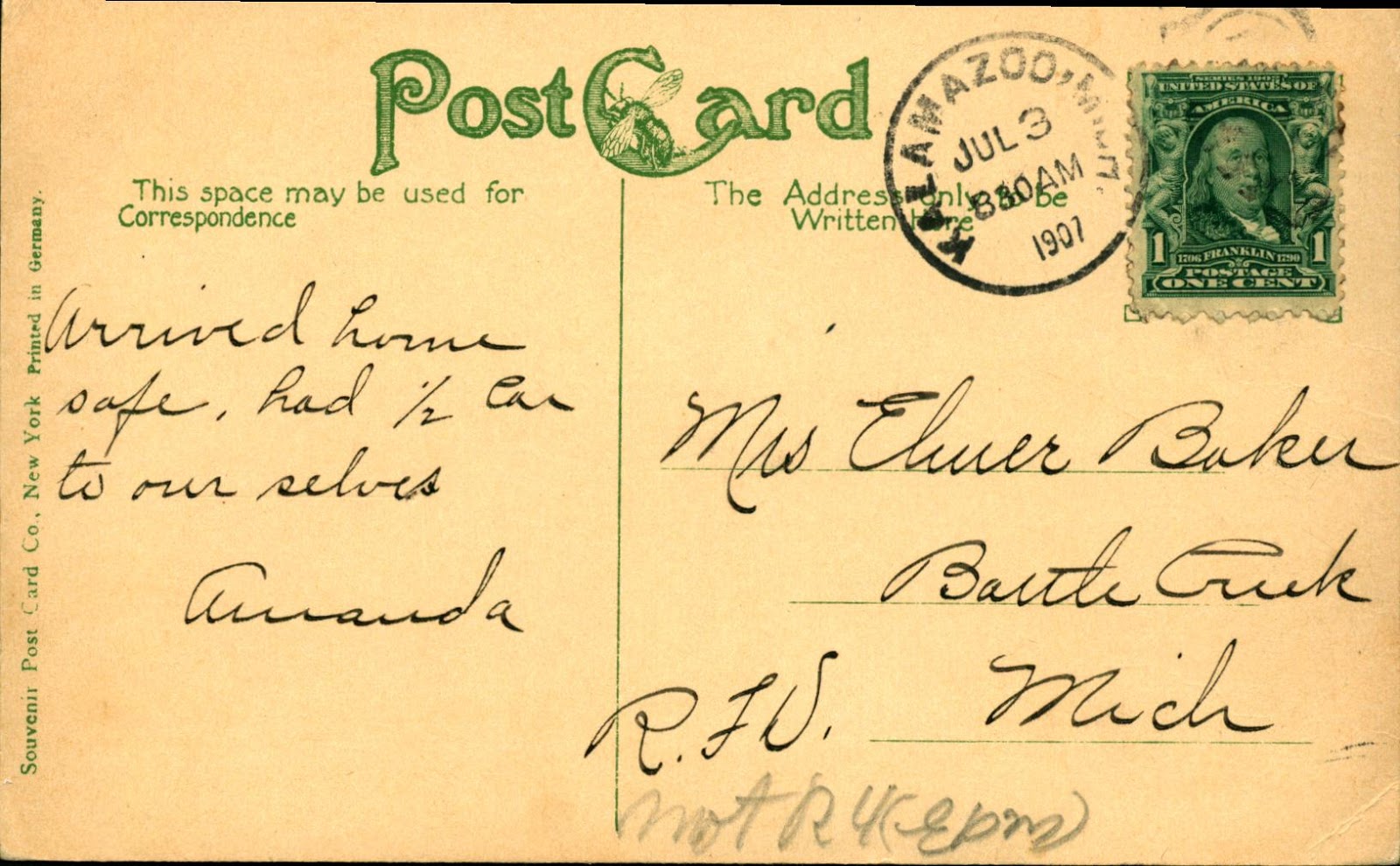
1907 Public Library, Kalamazoo, Michigan
[LIB8040] The origins of the Kalamazoo Public Library were humble. In 1860 the local school district inherited 123 volumes from a failed township library. With that tiny collection, a library was opened for a single hour per week, its use limited to students of the school district and their parents. It grew through the Civil War years until it had 2,800 books, and opened to the general public on 12 October 1872. From that modest beginning, Kalamazoo Public Library has continued to grow until it now offers 120,000 people almost 400,000 books and a variety of other media from five buildings. [Website]
1912 Public Library, Elwood, Indiana
Friday, April 26, 2013
1910 Public Library, Melrose, Massachusetts
[LIB8038] - Color tinted postcard published by The Rotograph Co., N.Y. City. (Germany)
With the arrival of the twentieth century, the fifty year old Town of Melrose became a City -- a City that had grown in half a century from 1,200 to 12,000 citizens. Aware of the urgent need for a larger library facility, Mayor John Larrabee and other citizens persuaded Andrew Carnegie to make a substantial contribution for the construction of a library building. A handsome new building, recognized as the basis for the present enlarged plant, was erected on the West Emerson Street site of the old High School, which had been destroyed by fire in 1897. [Website]
Kendal Young Library, Webster City, Iowa
[LIB8037] - Early in the history of Hamilton county there came to Webster City two men whose memory will ever be cherished by a grateful people. These were Kendall Young and Jacob M Funk. They were both capitalists and men of financial genius but both were retiring and modest in general conduct. Kendall Young had no children and Jacob Funk had neither wife nor children. In many respects they were opposite from each other. Kendall Young was a republican, Jacob Funk was a democrat. Kendall Young was a down town man while Jacob Funk was an up town man. Kendall Young was a banker and conducted his business in a most orderly and systematic manner. Jacob Funk was a farmer, builder, landlord and man of many diversified interests and usually kept his accounts in his head. Both agreed however, in a good opinion of the city in which they lived and of its people, their neighbors and friends. Kendall Young established the Kendall Young Library. Jacob Funk founded Mercy Hospital. Both were public benefactors in a large and unusual degree. [http://bit.ly/ZMUm4V]
Subscribe to:
Posts (Atom)


.jpg)